
Goals 106: Plan to Fail
by Carl Raghavan, SSC | January 12, 2026
I see this time and time again – setting ambitious yearly goals in
January. I get it, having goals is important, I have several articles
on the subject. The new year feels like the perfect warm and fuzzy
time to start fresh. But more often than not, people make grand
plans, take no real accountability, and end the year disappointed
when nothing comes to fruition.
Every lifter
overestimates what they can achieve in a year and underestimates what
they can achieve in a decade.
I’m not immune to
this mistake either. In Prague, in August 2024, I pressed 150kg. When
2025 rolled around, I wrote down a new goal: press 160kg: a massive
10 kilo improvement. In the year that’s past I’ve been able to
press 150kg an additional 2 more times since I set this new heavier
goal. These lifts happened in August 2025 in Montpellier, and
November 2025 in Oklahoma.
In fact, my only
meaningful PR this whole year of 2025 was a 130kg power clean in
Putney at Physical Culture – a 10 kilo improvement, which happened
in the lead-up to Christmas in December.


Does that mean 2025 was a failure for my press? No. Did I not get
stronger the entire year? No. When you’re close to the upper end of
your strength potential, even a full year isn’t always enough time
for visible progress. At this level, adaptation slows, progress
becomes irregular, and simply repeating near-maximal performances can
be success in itself.
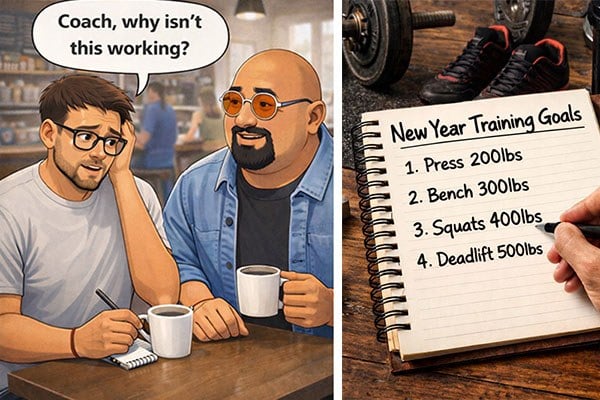
So back to a typical
circumstance I see. If last year your squat was 140kg, this year you
set a goal: “I’ll squat 180kg this year.”
Then life happens.
- You get sick
- You break your leg
- You take a long
vacation - You have a baby
- You lose your job
Life happens and
wishful thinking on paper falls short, hoping that visualising
another plate will magically make it real. If I can see it, then I
can do it. Right? Wrong.
The new year arrives
and your numbers look the same. It can feel like progress has
stalled, like you’re sitting in that fuzzy grey zone between
improvement and failure. But strength doesn’t always show up on the
bar. Static numbers don’t always mean no progress.
Does that mean you
failed?
No. That training for
that year has been an investment to one day climbing higher up the
ladder to achieving your goal. It means you’re technically stronger
– you have just not been in the right situation to demonstrate that
progress. Strength isn’t just PRs – it’s the ability to hold
onto your baseline even when life throws you a curveball.
Progress favors the
stubbornly determined, and in the end strength belongs to those who
refuse to quit.
Notice I didn’t say:
- Most talented lifters.
- Perfect genetics.
- Or have “the best
program.”
It belongs to the ones
who grind through setbacks, failures, and frustration without giving
up.
The lifters who succeed
aren’t the most talented or the strongest early on. They’re the
ones who stick to the plan longer than everyone else. They get back
under the bar no matter what life scenarios they face. They keep
lifting even when the numbers don’t move, or when the weight on the
bar scares them.
The real challenge is
making logical decisions instead of emotional ones when progress
stalls. Ask yourself:
- Does this lift need
more intensity? More volume? More recovery? - Or, especially for
novices, do you simply need to eat and sleep more or have better
technical mastery?
That’s it. Success in
training is rarely more complicated than that. Strength isn’t given
– it’s earned. And most of you will never earn it because you
didn’t have the patience to see it through. Remember: patience is a
virtue.
Success
isn’t linear. Embrace the setbacks. Learn from them. Get back under
the bar. Your day is coming.
Credit : Source Post