
February 23, 2026
Dwell Edition
On Starting Strength
-
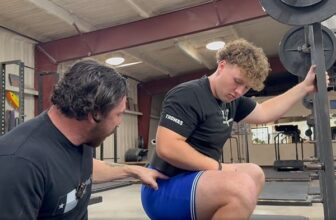
Best Collars? The Husker Powerlock –
Rip talks to Tanner Paxton about his favorite collars, the Husker Powerlock. They discuss it’s history, construction, and how it differs from other approaches to securing the plates on the bar. -
Showing Up by Robert Santana –
The basics are often boring, monotonous, slow changing things that you can’t slap on a billboard and expect a big return from. Big wins often require a series of small, incremental, and repetitive… -
Stop Throwing Your Press Forward –
Rusty talks about a common movement error starting the bar in the press that throws the bar forward and how to stop this from happening. -
Intermediate and Advanced Training: A Few Ideas by Rippetoe, Baker, Bradford –
Once a tiny fraction of the training population, post-novice trainees now comprise a rapidly expanding section of the market for training information. It is important that the logic and clarity… -
Why Fives? –
Starting Strength Seminar Staff Coach Brent Carter explains the continuum of rep ranges and why sets of five work best for strength training. - Weekend Archives:
Bill March: The Chosen One by Bill Starr –
Quite often, the degree of success that a person achieves in any endeavor in life is a result of being in the right place at the right time. Such was the case of Bill March, unquestionably one of the greatest… - Weekend Archives:
When to Omit the Power Clean by Mark Rippetoe –
As we have said many times, not everybody needs to do the power clean. This has been repeatedly interpreted to mean, “I don’t need to do the power clean.” Even more unfortunately…

In the Trenches

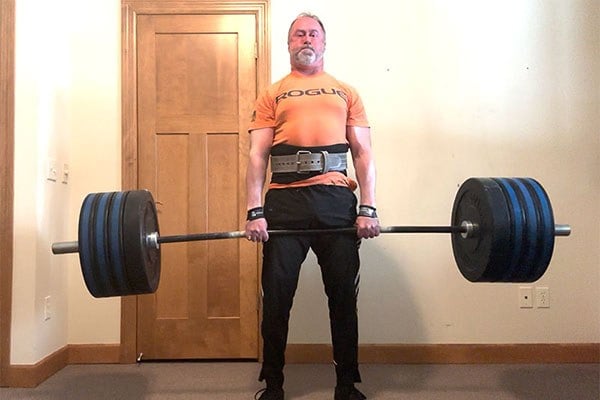
After left hip replacement on May 20, 2025 and right hip replacement 10 weeks later on July 29, 2025, Brian pulls 405 x 5 at 29 weeks post (2nd) surgery. [photo courtesy of Brian O’Malley]
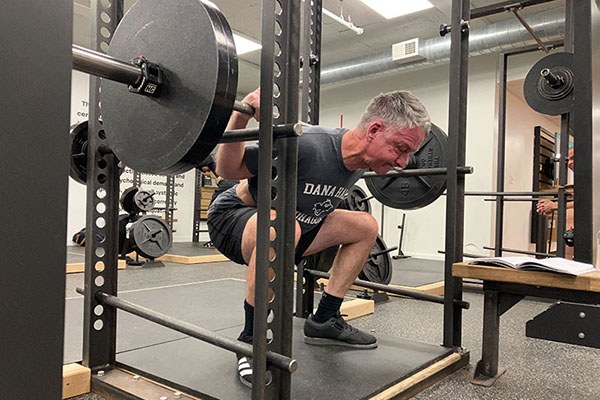
Brian, a trainee in his 60s, sets a squat PR of 225lb for 5 reps at Starting Strength Boston. [photo courtesy of Michael Shammas]
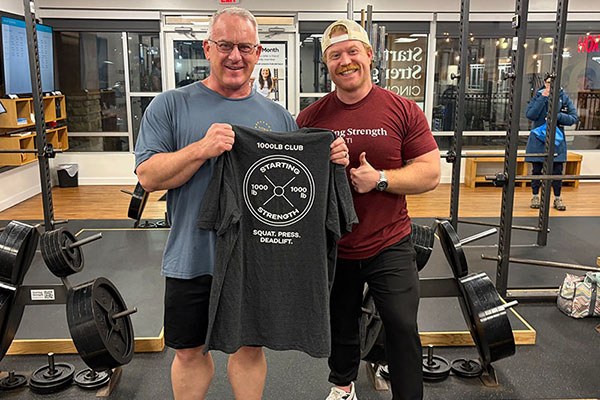
Starting Strength Cincinnati member Paul Sensel (left) poses with coach Shane Mounce after earning his place in the coveted 1000lb club. [photo courtesy of Luke Schroeder]
Get Involved
Best of the Week
Gain, Maintain, or Taper?
MiguelMcFly101
Hello, I am returning to the program after some detraining happened during the holidays. Something weird happened where every single one of my lifts lost progress save for my bench press. Right now I am at Deadlift: 210x5x3; Squat: 195x5x3; Bench Press: 177.5x5x3; Press: 107.5x5x3
Obviously they need to go up, and they’re going back up steadily. However, I am in a peculiar situation weight wise. I am 5’7 and 208lbs and at least 25% bodyfat. I’m wanting to eat more to fuel lifts since that was a problem I’ve had in the past, but I’m afraid that where I’m already at I’m gonna end up becoming strong and obese. Maybe I’m just being paranoid. Should I eat in a caloric surplus hoping for a recomp while I fuel my lifts? Would it be better to maintain? Or should I cut out the carbs and hope for the best?
Maybe the answer is obvious and I need to be smacked with a hammer. Godbless.
Mark Rippetoe
You are at a bodyweight of 210 with with a 210 deadlift, and you’re worrying about your bodyfat? Seriously?
Best of the Forum
high RHR
francis
Hi Rip, I am a complete novice at strength training, and starting late too. 49yo, 1’74”, 74Kg.
I got started recently with a 5×5 program, then found SS, read the book, also Barbell prescription, and plan to continue with SS.
However, I have one concern: I have a high RHR (average 95bpm determined via a 24h heart rate monitor). Recently seen a cardiologist (2 actually, the first on a few years back for the same issue), who has done echo, blood tests, ECGs etc and found nothing out of place. Diagnosis: I’m deconditioned. (the cardiologists I saw a few years back also found nothing out of place)
That does not take me by surprise as I’ve never been sporty or fit. Sill, the issue is that the cardiologist recommended exercise, I asked if lifting is ok, he said it’s better to do aerobics.
Now it’s not that want to assume the Dr does not know what he’s talking about, he is also someone that specialises in tachycardia, arrhythmias and so on, but I am also aware (partly thanks to the articles I read from you and others here, and on other sites), that there might be a bias towards recommendation for cardio vs resistance exercise in the medical and fitness professions. However, it is also well-established that steady-state activities such as cycling are very effective in lowering RHR, moreso than lifting, I believe.
I looked at some posts on the forum, and most people I’ve seen complaining for high RHR mention 60 (!)
My question is: with a RHR of 95, would it still be recommended to build strength via the SS linear progression, before introducing conditioning, or would it be better to build an aerobic base via, say, cycling first.
I realise this question might be too general, or starting from a misguided point of view, but put simply, I am concerned and can’t seem to think straight. There is a lot of conflicting information out there, even by official sources – for example, Strength training tied to better heart health than aerobic as opposed with a gazillion papers showing effects from cardio, and I can’t seem to figure what’s sound.
Mark Rippetoe
Let’s clear up some of this confusion first. How tall are you at 160 pounds? — 1 foot 74 inches is not really helpful. You say you have a high “resting heart rate”, and then you tell us that your 24-hour average HR was measured at 95, which is not unusual, but is not the same thing as RHR. At what elevation do you live? And if imminent cardiologists have detected no pathology, what symptoms (as opposed to signs) prompted you to go to the doctor?
As an important general question, what is better about a lower RHR than a higher RHR? Is it the fact that the general public equates a low RHR with competitive endurance athletes, which are the Obvious Pinnacle of Human Physical Performance Expression, and that in this regard Doctors are quite firmly in the general public cohort? There is a huge genetic component to cardiodynamics that is outside your ability to affect. Some people have small hearts, some people have huge hearts, the demands of endurance athletics favors the genetics that allow more blood to be pumped, but that doesn’t mean that a RHR of 80 is indicative of some type of inferiority in the absence of obvious problems that come with sitting on your ass all day.
Lastly, when you finally get your squat up to 365 x 5 x 3, report your HR to us at the end of the 3rd set.
francis
Sorry for being confusing, I meant 1m74. I checked the results of the 24h ECG, it’s max 150bpm measured at 5pm (I was probably walking somewhere, for sure not exercising), min 70 bpm (at 4am, I was sleeping), average 94. With regards to RHR, I measured several times over several weeks, and it tends to read around 95, more if I had dinner or I just came home or moved around a bit. I live in London, so at sea level.
What prompted me to see the Dr was, a few years back, to have a check up to see if the fast HR was indicative of an underlying problem. There wasn’t one, so I could have said case closed, I suppose.
But perhaps what worries me is that the vast majority of the people I know, including sedentary ones, have a much lower RHR, and also being aware of the fact that the expectation that a RHR above 85 is considered by the medical profession to be indicative of poor conditioning or some other issue – and also that at the population level a high HR is strongly associated with increased risk of all-cause and cardiovascular mortality.
Hence, my concern comes from the idea that there is something wrong and I have to do something about it. And the confusion is because the cardiologist I’ve seen recently said I should do aerobics and not lifting, and because I didn’t want to take it at face value (in good part on the basis of materials I read here).
But thanks for your reply – I think I see what you mean and it is helpful. I will check my HR as you said, but why are you asking? Is the expectation that by the time I get to lift 365, HR it would be reduced overall?
Mark Rippetoe
I don’t care about your HR, or your cholesterol level, or your blood pressure. I care about your health, not a doctor’s pulled-out-of-his-ass opinion. You are a 49-year-old man with no heart disease, and if you want to lift weights, I think you should lift weights. If you want to run to satisfy your doctor, then that’s what you should do. Both of these activities elevate your heart rate, but only one of them makes you stronger.
Credit : Source Post