

February 09, 2026
Sloosh Edition
On Starting Strength
-
Things the General Population Should Know –
Rip and Rusty talk about the prevalence of machines in gyms, their limitations, and how to upgrade to training with barbells. -
The Problem Isn’t Video by Doug Diller –
Starting Strength gyms famously avoid mirrors. The reasoning is straightforward: when lifters watch themselves during a lift, attention shifts away from the task and toward self-correction in real time… -
Dumbbells at the WFAC –
Rip why dumbbells are a fundamentally different tool than barbells and their limited use for strength training. -
IJGTWOT by stef bradford –
A statement often thrown around at the gym or in online discussions of training is “I’m just going to work on technique.” It’s one of two or three of those Things People Say that put me at risk… -
Setting the Knees Early During the Squat –
Starting Strength Coach Steve Ross helps you with fixing your knee position during the squat. - Weekend Archives:
Are You Training Effectively For Your Sport? by Chris Olson –
My first “career gig,” well before becoming a Starting Strength Coach, was coaching competitive youth soccer. In the soccer world, I couldn’t help but marvel at how well parents… - Weekend Archives:
Strength Training, CrossFit, and “Functional Training” by Mark Rippetoe –
Strength, as you already know, is the ability to exert force on physical objects. Skill is the learned ability to carry out a task within a definable framework of time and energy. Neither of these…

In the Trenches
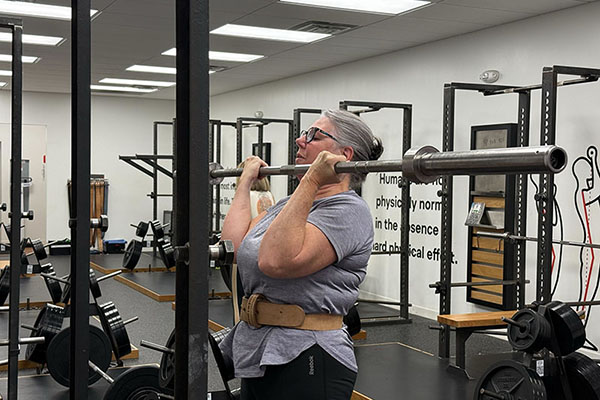
After the day’s squats, pressing movements, and deadlifts are done, Carol Hoover from Starting Strength Atlanta gives the expression “curls for the girls” a whole new meaning. [photo courtesy of Starting Strength Atlanta]
Get Involved
Best of the Week
A question for the man who would know…
ML3971
Rip, I recently listened to Starting Strength Episode #87 with SSC Chase Lindley where you discuss how some people are just able to do a double layback in the press. It was made pretty clear at the time of recording, that a method for coaching the double layback wasn’t yet in existence. I’ve since read “The Double Layback: A Lifter’s Approach” and “The “Standing Bench Press”” on the website, but neither really have a great way of “teaching” it.
I am 23, male, self coaching as best I can, and currently press 195 pounds for 5 sets of 3 at a bodyweight of 225. While this is not necessarily impressive for my age and weight, I do enjoy pressing heavy and would like to give the double layback technique an honest shot as I add weight to the bar. Has there since been a method developed that a guy in my position could follow? Or am I at the mercy of natural instinct under the bar as it continues to get heavier?
Mark Rippetoe
I can probably coach it effectively, but it would have to be in person.
stef
It can help to remember that the press is an Olympic lift and treat it that way, including starting from the floor.
Have a look at this old video series from Tommy Suggs as well: The Olympic Press with Tommy Suggs
Best of the Forum
How Can I Measure and Assess Anthropometry
SquareOne
Hi, sorry if I’ve missed something obvious in the many resources available, but I would greatly appreciate it if you could direct me to information on:
1) How to measure torso, femur and tibia length according to some standard, like, from what point to what point, etc., and
2) Once I’ve done that, how to determine whether I have long/short femurs, torso, etc., in other words, I need some standard of comparison.
I see lots of references by coaches to clients with long femurs, short torsos, etc., and I would like to determine my own proportions; there must be a usable reference somewhere.
Mark Rippetoe
Why is this important? Do you intend to have yourself adjusted?
SquareOne
No, I’m maladjusted and might as well keep it that way. But I have some squat struggles and although my working assumption has been that I’m just a physical idiot who can’t get it together enough to follow a few simple cues, I also gather that to at least some extent anthropometry is destiny, and I would very much like to know mine.
Specifically I gather that different people might have different optimal back angles at the bottom of the squat depending on their proportions. (Specifically, I’m wondering if the only way for me to get the bar at least in the same zip code as midfoot is to have somewhat more vertical back angle, even though I’ve been properly conditioned to abhor anything involving verticality. At all weights the bar always sweeps forward to my toes or further, even when I’m cueing myself into oblivion.)
Even in the blue book you make several references to people with short legs/long torsos or whatever, and that that can effect certain approaches to the squat, and on form checks and lots of other places coaches will comment on someone’s short femurs or something. I realize that many coaches have seen so many thousands of torsos and femurs and tibias that they just know. But there must be some standardized way I can measure and figure out on my own where my own proportions fall? Couldn’t hurt to know, and might help.
Still searching, but so far I can’t find anything useful, so I thought I’d go to the source.
Mark Rippetoe
Post a deadlift video.
SquareOne
Hi, sorry it took me so long to put up this deadlift video, I hope that somehow you will return to this thread to see it. I assumed that you meant for me to post the video here and not the technique forum, but I can do that too if that’s what you meant.
I have never video’d my deadlifts before, so I am ready for any lacerating comments about my form, in addition, hopefully, to any observations about anthropometry.
On a related issue, you might notice significant kyphosis in this video – because of that my upper back always looks rounded on the deadlift no matter what I do – and I’d like to add another question to the one about general anthropometry. My most significant challenge since starting this program has been thoracic flexion in the squat which, combined with the kyphosis, causes the bar, once I reach a certain weight, to roll forward almost onto my neck at the bottom of the squat, which causes a very undesirable situation. I am starting to understand that this situation is not uncommon for people with kyphosis.
Do you have any general observations about common effective adjustments people with kyphosis often have to make? I have been experimented with putting the bar even lower on my back, we’ll see how that goes. Obviously I have to fix my thoracic flexion, but so far attempts at that have not been enough. It seems to me an obvious fix might be to have a more vertical back angle so the bar is less likely to roll forward, but I have been well trained to be allergic to anything with the word “vertical” in it, and I am afraid that might compromise my ability to be in my hips, etc. Any observations from your experience might be very helpful.
Let me add to that, that at all weights I am pretty much unable to keep the bar above mid foot (on the squat). No matter what I try it drifts forward, almost to my toes, or further. Possible anthropometry explanation, or am I just a physical idiot?
Mark Rippetoe
You have long arms, and should be a good deadlifter. But I see absolutely no effort being made to finish the pull in full thoracic extension at the top, i.e. you are not lifting the chest at lockout. You do have an anatomical kyphosis — so do I, and so do lots of people, but that doesn’t keep you from doing the last 5% of the work at the top of the pull. As far as the mid-foot shit is concerned: Understanding the Master Cue | Mark Rippetoe
Credit : Source Post